
Polyurethane vs. Rubber
Comparing polyurethane vs rubber starts with the type of rubber and the demands of your application. Natural rubber, neoprene, and nitrile each offer different strengths, but urethane can provide advantages where abrasion, tearing, or heavy loads cause premature part failure. PSI Urethanes helps you evaluate these materials and select standard urethane sheets or custom formulations suited to your operating conditions. Explore urethane vs rubber below, including polyurethane vs neoprene and polyurethane vs nitrile, or contact our team to discuss your part.
Benefits
These seven benefits show how standard urethane sheets compare with rubber and its variations. Each one shows how urethane vs rubber plays out in real applications.
Ask Our Experts.
Contact us today to learn how we can meet your project’s requirements.
Durometers
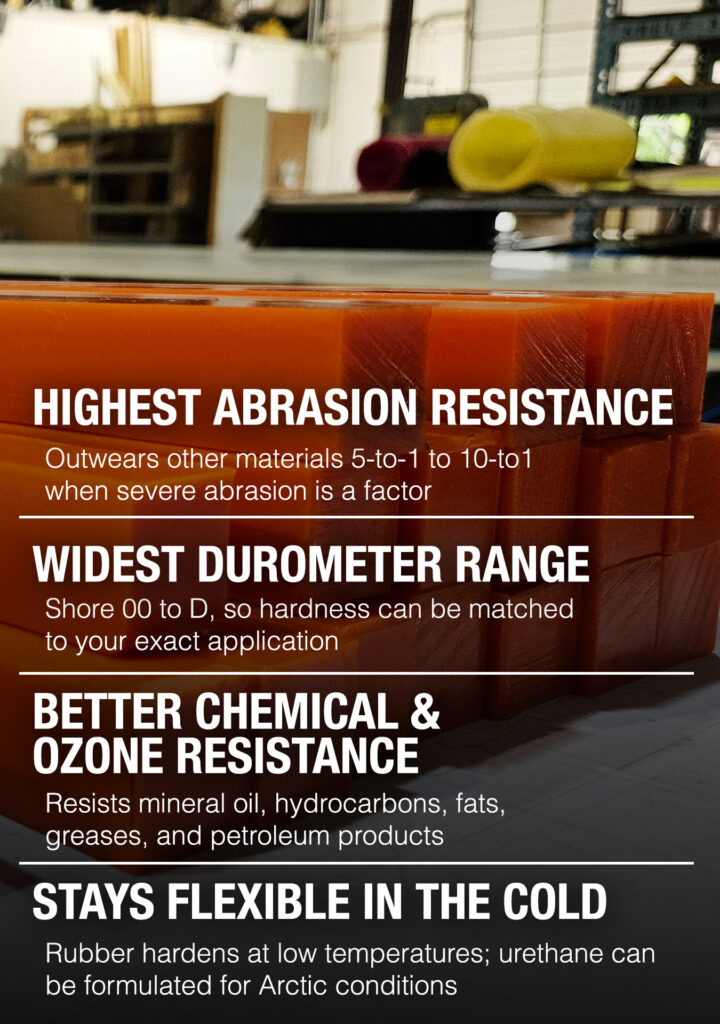
Unlike rubber, we can manufacture from “OO” to “D” scale material to suit almost any application.
Sound and Vibration Dampening
As urethane is an insulator, our standard or custom formulations can be geared toward your specific requirements for either application.
Self-Sealing
This makes urethane ideal for tabletops and backing pads for dies.
Abrasion Resistant
When severe abrasion is a factor, urethane has been known to outwear other materials by a factor of five-to-one to ten-to-one.
Resistant to Most Chemicals
When it comes to chemicals and ozone, urethane surpasses rubber. Urethane will maintain excellent resistance to mineral-based oils, hydrocarbons, fats, greases, petroleum products, and specific solvents.
Customizable
PSI carries a wide variety of resins, curatives, and additives. This allows us to alter formulas to be customer specific.
Flexibility
Urethane remains flexible at low temperatures, while rubber tends to harden. The technicians at PSI can even formulate urethane to remain flexible in Arctic-like conditions and temperatures as high as 250° Fahrenheit or to sustain sudden drops in temperature.
Polyurethane vs. Specific Types of Rubber
Rubber is not one material, so the comparison changes with each type. Polyurethane vs rubber gets more specific once you name the rubber, and three common types show where urethane gains the most.
Polyurethane vs. Natural Rubber
Natural rubber is highly elastic, but urethane offers greater abrasion resistance, higher load capacity, and better resistance to oils and ozone. Switching suits parts that see sliding wear, heavy loads, or oily surfaces.
Polyurethane vs. Neoprene
Polyurethane vs neoprene favors urethane on abrasion resistance, tensile strength, and tear strength. Neoprene is known for weathering, but urethane can be custom-formulated to balance chemical resistance with far greater wear life.
Polyurethane vs. Nitrile (Buna-N)
Polyurethane vs nitrile is closer on oil exposure, since nitrile excels at oil resistance. Even so, urethane offers higher load capacity and longer wear life, and PSI can formulate it for your chemical exposure.
The table below compares polyurethane vs neoprene, polyurethane vs nitrile, and natural rubber property by property. Hardness range matters because urethane vs rubber choices often hinge on how precisely a part can be tuned.
Swipe left or right to compare all materials.
| Property | Polyurethane | Natural Rubber | Neoprene | Nitrile |
|---|---|---|---|---|
| Abrasion resistance | Highest | Lower | Lower | Lower |
| Oil resistance | Excellent | Poor | Moderate | Excellent |
| Ozone resistance | Excellent | Poor | Good | Poor |
| Hardness range | OO to D | Narrower | Narrower | Narrower |
When to Choose Urethane Over Rubber
Engineers and buyers often start with a worn rubber part and ask what will last longer. If abrasion, oils, ozone, or load are your main concerns, urethane is usually the stronger choice. Our urethane sheeting suits flat wear parts, our cast urethane products cover custom shapes, and PSI can bond urethane to metal. Rubber can still be preferable for very high-heat or high-elongation uses, so we help you weigh polyurethane vs rubber for your part. Share your load, temperature range, and fluid exposure, and we will help you pick the right grade.
Polyurethane vs. Rubber FAQs
These answers cover the questions buyers ask most when comparing the two materials.
Is polyurethane better than rubber?
For most industrial wear applications, yes. Polyurethane outperforms rubber in abrasion resistance, load-bearing, and resistance to oils, chemicals, and ozone, and it offers a far wider durometer range. Rubber can still be preferable for very high-heat or high-elongation uses.
Does polyurethane last longer than rubber?
Yes. In high-abrasion applications, urethane has been known to outwear other materials by a factor of five-to-one to ten-to-one, which often lowers total cost by reducing downtime and replacement frequency.
How does polyurethane compare to neoprene and nitrile?
Polyurethane generally beats both neoprene and nitrile on abrasion resistance, tensile and tear strength, and load capacity. Nitrile excels at oil resistance and neoprene at weathering, but urethane can be custom-formulated to balance chemical resistance with far greater wear life.
What durometers can polyurethane be made in versus rubber?
PSI casts polyurethane across the full range, from Shore OO 25 to Shore D 70, so hardness can be matched to the exact application. Rubber is limited by comparison, which restricts how precisely it can be tuned.
Does polyurethane resist chemicals better than rubber?
Yes. Urethane maintains excellent resistance to mineral-based oils, hydrocarbons, fats, greases, petroleum products, and specific solvents, and it resists ozone where many rubbers degrade.
Request Your Urethane Quote
Tell us about your part, and PSI will recommend the right formulation and durometer. Request a Quote to compare polyurethane vs rubber for your part, or Contact Us with any questions you have. Our technicians review each application before recommending a material, so you get a clear answer on cost, durometer, and wear life.