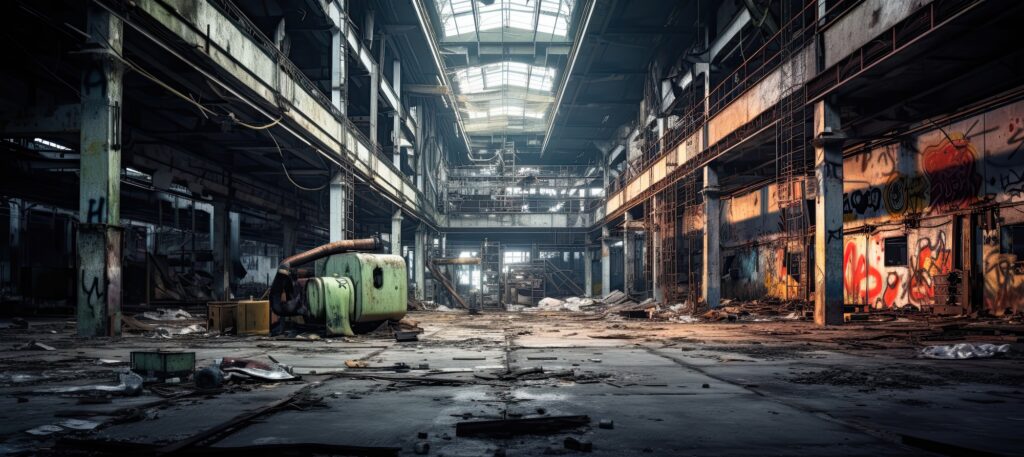
Picture a scenario where infrastructure breaks down faster than replacement parts can arrive. Power grids flicker. Supply chains stall. Lubricants run low. Chemical exposure increases as containment systems degrade. Abrasion, impact, moisture, and contamination become daily realities rather than edge cases.
This is not a story about zombies or cinematic explosions. It is a stress-test thought experiment, one that strips away ideal conditions and asks a more practical question: What materials still function when maintenance intervals disappear and replacement options vanish?
Extreme environments reveal weak material decisions quickly. Rubbers swell. Plastics crack. Metals corrode, seize, or deform. What survives longest are materials that tolerate abuse without constant attention.
Most conventional materials fail for predictable reasons when conditions deteriorate.
Rubber components absorb oils and fuels, leading to swelling, loss of shape, and tearing. Plastics suffer brittle fracture, creep under sustained loads, or shatter under impact once temperatures swing or UV exposure increases. Metals resist impact well but introduce other problems: corrosion, galling, lubrication dependency, and weight penalties that make replacement difficult when lifting equipment or manpower is limited.
Cast polyurethane occupies a different category, it is an elastomer that can resist impact and carry heavy loads. It absorbs energy rather than cracking, resists abrasion instead of wearing away rapidly, and continues functioning without lubrication in many applications.
Built for abuse, not assumptions. See how custom cast urethane can solve your toughest material challenges.
Polyurethane chemical resistance is not a lab label, it is how a material responds after prolonged exposure to oils, greases, fuels, solvents, washdown agents, acids, and bases. In uncontrolled environments, exposure is rarely brief or clean.
Cast polyurethane resists swelling and breakdown far better than many rubbers when exposed to hydrocarbons and lubricants. Unlike some plastics, it does not become brittle after repeated chemical contact. Instead, properly formulated urethanes maintain structural integrity and shape over long exposure periods.
PSI Urethanes builds this polyurethane chemical resistance at the formulation level. Rather than relying on generic compounds, PSI tailors urethane chemistry to match specific exposure profiles. Whether a component lives in hydraulic oil, fuel splash zones, or aggressive cleaning cycles, the formulation is adjusted accordingly.
In a degraded environment, fluid handling systems rarely operate under ideal conditions. Fuel lines, pumps, and transfer points see contamination and inconsistent chemical mixes. Cast urethane liners and seals tolerate these conditions without rapid breakdown.
Water and food systems face constant chemical sanitization. When disinfection is aggressive and continuous, many materials degrade quickly. Polyurethane sheeting and molded parts resist repeated exposure while maintaining shape and function.
Protective liners in corrosive environments (sumps, chutes, and containment areas) benefit from polyurethane chemical resistance to both chemical attack and abrasion, especially when metals would corrode and rubbers would soften.
Impact resistance is all about absorbing repeated shock without crack propagation or material fatigue. Plastics tend to fracture under sudden loads. Metals transmit shock rather than dissipate it, often damaging adjacent components.
Cast polyurethane absorbs energy elastically. It displaces under load, then recovers without permanent damage. This same molecular structure resists abrasion from sliding contact and slows tear growth under cyclic loading.
PSI urethanes are formulated to handle repeated shock loading without developing microcracks that eventually lead to failure. That trait becomes critical when downtime cannot be tolerated and replacement parts are unavailable.
Material handling systems are unforgiving when spare rollers, guides, or bumpers are gone. Urethane components survive constant impact from misaligned loads, dropped items, and vibration that would destroy plastic alternatives.
Protective guards and wear pads in high-impact zones prevent structural damage elsewhere. When a single failed component can shut down an entire system, energy-absorbing materials become the last line of defense.
Heavy equipment benefits as well. Urethane components reduce replacement frequency and weight, lowering the physical burden of maintenance when manpower and tools are limited.
Dealing with impact, chemicals, or constant wear? Talk with PSI Urethanes about a part designed to last.
Rubber struggles in chemically aggressive environments. Oils and fuels cause swelling that leads to dimensional instability. Ozone and UV exposure accelerate surface cracking. Under cyclic loads, small tears propagate quickly, leading to sudden failure.
Temperature swings worsen these effects. As rubber stiffens in cold conditions or softens under heat, load-bearing capability drops sharply.
Cast polyurethane carries higher loads at comparable hardness levels. It resists abrasion far longer and maintains shape under compression. These traits translate into fewer replacements and longer intervals between interventions.
PSI Urethanes offers an unusually wide hardness range, from 25 Shore OO to 75 Shore D, allowing engineers to fine-tune flexibility, load capacity, and impact response for each application. That range becomes a design lever when conditions are unpredictable and conservative margins matter.
Not all urethane is created equal. PSI Urethanes brings over five decades of formulation experience to every part, refining chemistry based on real-world failure data rather than catalog assumptions.
In-house mold making allows tighter dimensional control and rapid design iteration. When a part must fit correctly the first time (because rework is not an option) this capability becomes decisive.
PSI scales components from small precision parts to castings exceeding 2,500 pounds. That range matters in environments where standard materials fail across both small and large assemblies.
Sheet stock produced to precise thickness standards, held to ±0.005 inches, reduces stress concentrations and uneven wear. Small dimensional inconsistencies often trigger premature failure under load; controlling them extends usable life.
Custom colors, hardnesses, and specialty formulations expand application coverage. FDA-approved compounds support food and water systems. Fire-resistant and static-dissipative formulations address safety risks in volatile environments where ignition control matters.
Food systems face relentless exposure to moisture, cleaning agents, and abrasion. FDA-approved urethanes withstand repeated washdowns without softening or cracking. When sanitation cycles intensify, these materials maintain shape and function where alternatives fail.
Press pads, dies, and wear components endure constant impact and sliding contact. Urethane reduces metal-on-metal damage while absorbing shock loads. In environments where tool replacement is difficult, this material choice extends usable service life dramatically.
Static-dissipative and fire-resistant urethanes support safety-critical systems where electrical discharge or flame risk cannot be ignored. These formulations maintain material integrity under stress while reducing secondary hazards in confined or volatile settings.
When off-the-shelf parts disappear, customization becomes a necessity rather than a luxury. Designing components for a specific application reduces reliance on frequent replacement.
PSI’s process (from quote to mold, prototype, and production) supports this approach. Rapid turnaround allows engineers to lock in designs that solve recurring failure points instead of treating symptoms repeatedly.
Designing a part once, correctly, changes the maintenance equation entirely. In both extreme scenarios and normal industrial settings, fewer interventions translate into more stable systems and lower long-term risk.
Extreme scenarios expose weak material choices faster than any controlled test environment. When conditions deteriorate, materials that rely on ideal maintenance schedules and clean exposure fail quickly.
Polyurethane chemical resistance, ability to absorb impact, and long service life make it a logical choice when failure is unacceptable. PSI Urethanes takes those inherent traits and turns them into engineered solutions matched to real exposure conditions, real loads, and real consequences.
Designing for worst-case scenarios has a side effect: everyday systems become easier to manage. When components survive abuse without constant attention, reliability improves even under normal conditions.
Stop replacing the same part over and over. Let’s design a urethane solution that holds up.
It refers to how well polyurethane holds its shape and strength after long-term exposure to oils, fuels, solvents, acids, bases, and cleaning chemicals, especially when exposure is messy, frequent, and uncontrolled.
Cast polyurethane absorbs shock by flexing under load and returning to its original shape, instead of cracking or shattering like brittle plastics can under sudden impacts.
Polyurethane typically outlasts rubber in harsh conditions because it resists abrasion better, handles higher loads, and is less likely to swell or deform when exposed to oils and fuels.
PSI Urethanes engineers material performance at the formulation level, matching urethane chemistry to real exposure conditions and loads, so parts maintain durability, fit, and wear life longer in demanding applications.