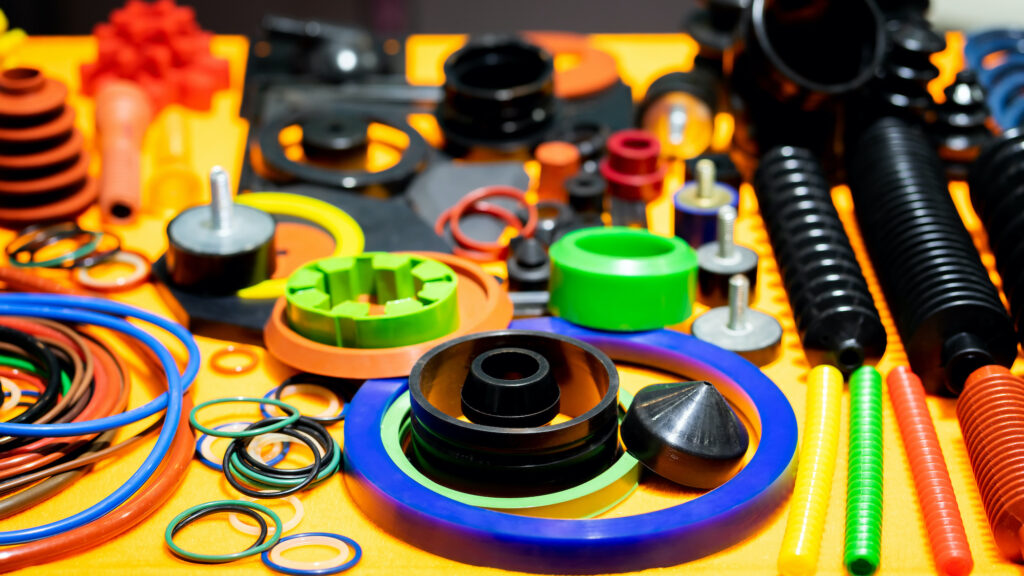
Steel has long been the default material for industrial components thanks to its stiffness and load-bearing capability. But modern equipment pushes materials harder than ever, higher speeds, continuous motion, abrasive media, and complex mechanical forces expose steel’s limits, including deformation, chipping, corrosion, and the direct transmission of impact loads.
These challenges have driven engineers toward advanced polymers, with cast urethane standing out. Its segmented molecular structure enables controlled elasticity, strong resistance to wear, and the ability to dissipate energy without fracturing. Urethane can also be tuned across a wide hardness range, giving engineers precise control over load response and abrasion behavior.
With an in-house mold shop, custom formulations, and casting capabilities for parts from sub-gram sizes to over 2,500 pounds, PSI delivers engineered urethane components and sheet stock that serve as reliable metal alternatives for industrial equipment, and a technical upgrade over traditional steel.
To understand why many industries now replace steel with urethane, it helps to compare the two materials at the mechanical level. Steel is strong, rigid, and heavy. Urethane is adaptable, energy-absorbing, and surprisingly strong relative to its weight. When engineers evaluate parts based on tensile strength, tear resistance, abrasion resistance, impact behavior, elasticity, and compressibility, urethane often excels.
This adaptability is a hallmark of urethane mechanical properties, allowing PSI to create formulations that match specific application demands.
Steel’s weight and stiffness make it prone to permanent deformation under impact or vibration. In contrast, urethane is lighter, more flexible under load, and capable of absorbing energy without structural damage.
This difference matters in real industrial environments. When components experience continuous shock, movement, or vibration, urethane reduces the forces transmitted through machinery. This leads engineers in many sectors to replace steel with urethane as a practical way to reduce wear on surrounding assemblies and improve machine reliability.
Ready to see how custom urethane can outperform traditional metal parts? Let’s discuss your next project.
When companies begin shifting from metal components to cast urethane, several clear advantages become immediately noticeable across a wide range of industrial applications.
In many equipment categories, urethane offers advantages that steel cannot match, especially where vibration, abrasion, or repeated impact are present.
These applications show how urethane consistently steps in when steel cannot meet the demands of modern industrial environments.
Have a challenging application or a component that steel can’t handle? PSI Urethanes specializes in custom solutions built for real-world demands.
Urethane’s adjustable hardness is one of its key strengths. With durometers ranging from 25 Shore OO to 75 Shore D, PSI can produce materials that behave like soft elastomers or rigid plastics, giving engineers flexibility when considering alternatives for steel.
Its chemical resistance is equally important. Urethane withstands oils, solvents, fuels, moisture, ozone, and UV exposure, and PSI offers specialized formulations, such as static-dissipative and FDA-approved grades, for environments where steel often requires added treatment.
Urethane also manages load and repeated motion well. It compresses and rebounds without permanent change, making it suitable for parts exposed to constant cycling where steel may fatigue.
Urethane can also handle abrasions and tearing far better than metal. Steel can chip or pit under harsh flow, while urethane wears more uniformly, which is why PSI often helps customers replace steel with urethane in liners and impact components.
Urethane offers design freedom that steel simply can’t match. PSI’s in-house mold shop supports rapid development of custom geometries, making it possible to cast shapes that would be difficult or costly to machine from metal. This casting flexibility also creates cost advantages, especially for low-volume or specialized components, since urethane reduces machining steps, material waste, and turnaround time, important factors for companies evaluating alternatives for steel.
Urethane also adapts well to industry-specific demands. PSI formulates static-dissipative urethanes for aerospace, fire-resistant grades for automotive environments, FDA-approved materials for food processing, and abrasion-resistant options for high-wear systems. Across these sectors, engineers frequently replace steel with urethane because it handles unique stresses and environmental conditions more effectively than rigid metal parts.
Steel has shaped industrial machinery for generations, yet modern mechanical demands increasingly reveal its limits. Cast urethane provides engineers with a more adaptable material, able to absorb shock, reduce noise transmission, withstand chemical exposure, and maintain stability under varied loading conditions. Its tunable hardness, predictable wear patterns, and ability to dissipate impact forces make it well-suited for equipment that experiences continuous motion or abrasive environments, even under rapidly changing industrial constraints.
PSI Urethanes advances this capability through specialized formulations, precision casting, in-house mold development, and engineered urethane sheet stock. These resources help engineers upgrade legacy systems or design new assemblies with improved mechanical consistency.
With PSI’s technical expertise and custom manufacturing support, integrating urethane into critical components becomes a direct, high-value progression aligned with modern industrial requirements and evolving application demands.
What could advanced cast urethane do for your equipment? Reach out today and talk with our engineering team.
Engineers replace steel with urethane because it offers controlled elasticity, impact absorption, abrasion resistance, and tunable hardness—advantages that help reduce deformation, noise, shock, and corrosion in demanding industrial environments.
Urethane is highly abrasion-resistant, flexible under dynamic loads, resistant to chemicals and corrosion, and capable of dissipating energy instead of cracking or deforming. Its durometer range also allows PSI to tailor hardness based on the application.
Applications such as rollers, couplings, seals, liners, bumpers, and impact-absorbing components often benefit most. These parts experience vibration, shock, abrasion, or repeated cycling—conditions where urethane outperforms steel significantly.
PSI uses custom formulations, in-house mold development, and precision casting to engineer urethane components that match exact load, wear, chemical, and environmental requirements—often creating geometries that would be difficult or expensive to machine from steel.