
Urethane Machining & Custom Machined Polyurethane Parts
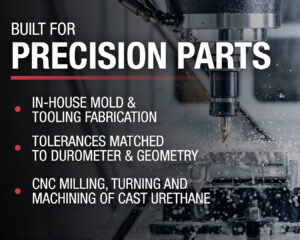
PSI Urethanes provides urethane machining for cast polyurethane parts that require precise dimensions, tight features, or a finished surface. Our CNC capabilities also support in-house mold machining, giving OEMs and MRO teams one source for custom polyurethane parts and tooling.
Ask Our Experts.
Contact us today to learn how we can meet your project’s requirements.
What Is Urethane Machining?
Urethane machining is the process of cutting, turning, grinding, drilling, or finishing cast polyurethane to precise dimensions using CNC equipment. Because urethane is flexible and heat-sensitive, it machines differently than metal or rigid plastic and requires the right tooling, speeds, and fixturing. PSI machines both cast polyurethane parts and the aluminum molds used to produce them.
In-House CNC Machining Capabilities
PSI combines engineering experience with CNC equipment to machine urethane and related tooling in-house.
Machining Cast Polyurethane Parts
CNC machining urethane allows PSI to add holes, slots, profiles, and other features after casting. Softer durometers may require different machining methods than harder materials, but both can be machined when the process is matched to the material and geometry.
Custom Mold Machining & Tooling
PSI machines its own metal tooling using a CNC mill and multiple CNC lathes, supporting intricate designs without relying on an outside machine shop.
For proof-of-concept parts, rapid prototypes, small runs, and one-off parts, PSI can also use 3D-printed molds when appropriate, providing flexible tooling options based on part complexity and quantity.
Materials & Tolerances We Machine
Achievable tolerance depends on the polyurethane’s durometer, part size, wall thickness, and geometry. Softer materials may deflect during cutting, while harder grades offer better dimensional stability.
PSI reviews your application requirements to determine practical machining specifications. For custom urethane molds, we can also review the tooling requirements alongside the finished part.
Urethane Machining vs. Molding to Net Shape
- Machining
- Well suited to prototypes and low volumes
- Adds precise features to cast parts
- Useful for finishing molded parts
- Flexible for design changes
- Molding to Net Shape
- Well suited to higher production volumes
- Produces consistent molded geometry
- Can reduce secondary machining
- Efficient for repeat production
Many projects use both methods. A part can be cast close to its final shape and then machined to meet the required dimensions.
Industries We Serve
PSI supports OEM, MRO, and manufacturing applications across industries like metal forming, mining, automotive, and automation. Machined polyurethane parts help meet custom dimensional and design requirements.
Request a Urethane Machining Quote
Need custom urethane parts? Contact PSI Urethanes for your quote today.
Frequently Asked Questions
Here are some answers our customer asks about urethane machining:
Can polyurethane be CNC machined?
Yes. Polyurethane can be CNC machined on mills and lathes to add features, tighten tolerances, or finish a molded part. Softer durometers flex under tool pressure and need adjusted feeds, speeds, and workholding, while harder durometers machine more like rigid plastic.
What tolerances can PSI machine urethane to?
Achievable tolerances depend on the part’s durometer, size, and geometry, since softer urethanes deflect more during machining than harder ones. PSI’s engineering team reviews your drawing and recommends the tightest practical tolerance for your material and application. Send us your part specs, and we’ll confirm what’s achievable.
Should I machine or mold my urethane part?
Molding to net shape is usually best for higher volumes and consistent geometry, while machining is ideal for prototypes, low volumes, tight features, or finishing molded parts. Many parts use both: cast close to shape, then machined to final spec. PSI does both in-house, so we can recommend the most cost-effective path for your run size.
Does PSI machine its own molds?
Yes. PSI’s in-house mold shop uses a CNC mill and multiple CNC lathes to machine intricate aluminum molds. Building tooling in-house shortens lead times and often eliminates a secondary machining step. For small runs and one-off parts, PSI also offers 3D-printed molds at lower cost and faster turnaround.