

Home » Rapid Prototyping
- Jump To:
- Product System Details
- Industries
- Resources
Cast Urethane Prototyping & Rapid Prototyping
Polyurethane prototyping gives you the opportunity to validate a real cast urethane part before investing in expensive production tooling. At PSI Urethanes, we produce functional prototypes and low-volume production parts using 3D-printed molds for urethane alongside in-house machined tooling, so you can test the actual material, durometer, and performance your application requires.
Whether you’re evaluating urethane casting vs. injection molding or need a faster, lower-cost path to production, we can help you prove your design before committing to hard tooling. If other suppliers turn down your project because the order is too small or the geometry is too complex, we’re built to take on exactly those kinds of challenges.
What Is Cast Urethane Prototyping?
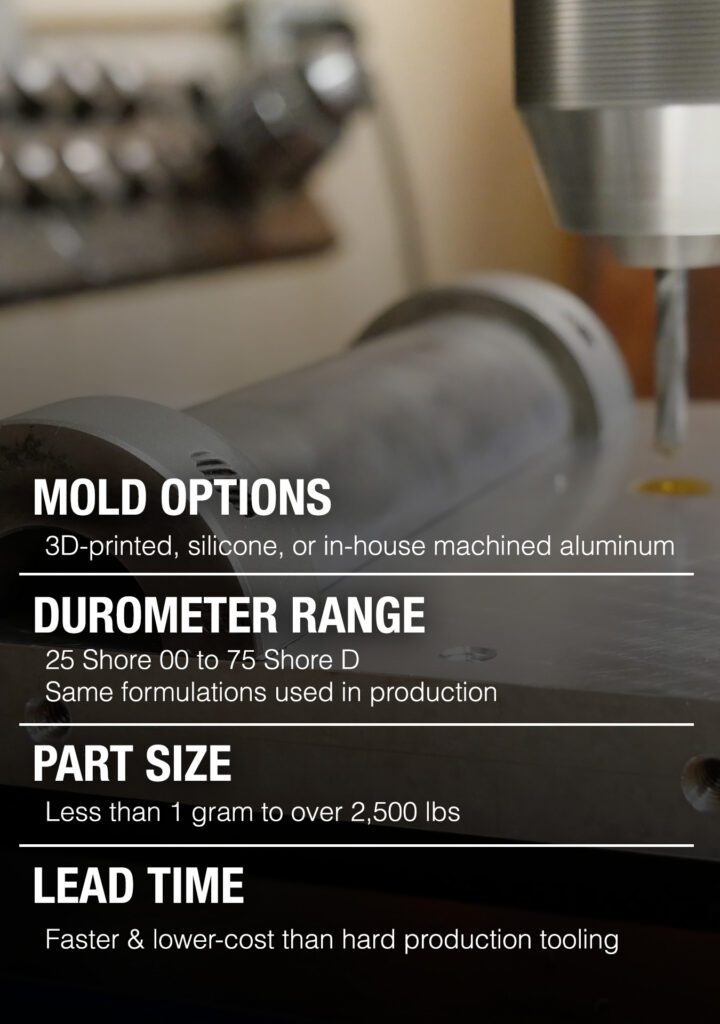
Cast urethane prototyping is a manufacturing process that pours liquid polyurethane into a mold to produce functional prototype and low-volume parts. The mold is often 3D-printed or made from silicone or machined aluminum. That makes it ideal for rapid prototyping and low-volume production: you get real, testable polyurethane parts with the abrasion resistance, impact resistance, and durometer you actually need, without the lead time and expense of production tooling.
The material will be the exact same that we use for full production.
When to Use Rapid Prototyping With Cast Urethane
Committing to a metal mold before a design is proven is a costly gamble. A single revision can mean re-cutting tooling, and if the part does not perform, that investment is gone. Cast urethane prototyping removes that risk.
Use rapid prototyping with cast urethane when you need to:
- Confirm fit, form, and function in a real polyurethane part before funding hard tooling
- Produce a handful of parts for testing, trade shows, or customer approval
- Bridge the gap between design and full production without stopping the project
- Iterate on durometer, geometry, or formulation before locking a design
3D-Printed Molds for Faster, Lower-Cost Prototypes
Our in-house mold shop has been built to move quickly. It includes a CNC mill and multiple CNC lathes, which let us machine intricate aluminum molds in-house and shorten lead times on custom orders, often by eliminating a secondary machining step.
For one-of-a-kind projects or small runs, PSI offers 3D-printed molds. When you need only a few parts, or you want to test a part before investing in a multi-cavity metal mold, a 3D-printed mold costs significantly less and delivers faster than traditional tooling. There are some limits on design, size, and surface finish, so ask your PSI sales associate whether your project is a good candidate.
From Prototype to Production
The advantage of prototyping with PSI is that you never have to change suppliers or materials to scale. We produce cast urethane parts ranging from less than a gram to over 2,500 pounds, and we are known for our willingness to take on short-run production, prototypes, and high-volume components alike.
That means the part you prove out in a prototype can move into low-volume and then full production in the same facility, with the same formulations and the same engineering support behind it.
In addition to standard and custom cast urethane parts, we also offer both standard sheets and precision urethane sheets for your own OEM die cutting needs.
Urethane Casting vs. Injection Molding
Both processes make polyurethane and plastic parts, but they solve different problems. The simplest way to choose is by volume and stage of development.
| Factor | Urethane Casting | Injection Molding |
|---|---|---|
| Best for | Prototypes, low-to-medium runs | Medium-to-high volume production |
| Tooling cost | Low (3D-printed, silicone, or aluminum molds) | High (hard steel tooling) |
| Lead time | Fast | Longer, driven by tool build |
| Design changes | Easy and inexpensive to revise | Costly to re-tool |
| Ideal stage | Early design and validation | Locked, high-volume design |
For prototyping and low-volume work, urethane casting is almost always the faster, more affordable path. Once a design is final, PSI’s open casting process can accommodate both small and large production runs, allowing you to move from prototyping into full production with support from our technical experts.
Custom Urethane Formulations for Prototyping
A prototype is only useful if it behaves like the real part, which is why formulation matters from the first run. PSI casts durometers from 25 shore OO, soft as a marshmallow, to 75 shore D, hard as a bowling ball, using in-house TDI ethers and esters, MDI ethers and esters, and aliphatic resins. If your application calls for a resin we do not stock, we can order it and manufacture your parts.
We also offer specialized formulations for demanding prototypes, including static-dissipative material, graphite-embedded urethane, and FDA dry and wet food-approved compounds, plus multi-durometer parts that combine hardnesses in a single component. Our engineering and technical staff work with you to match the formulation to the job before you scale.
Request a Cast Urethane Prototyping Quote
Whether you need a single prototype, a short run, or a path to full production, PSI Urethanes has the in-house tooling, formulations, and engineering support to get real parts in your hands quickly. Send us your part and we will help you find the fastest, most cost-effective way to cast it.
Ask Our Experts.
Contact us today to learn how we can meet your project’s requirements.
FAQs
What is cast urethane prototyping?
Cast urethane prototyping is a manufacturing process that pours liquid polyurethane into a mold, often 3D-printed or silicone, to produce functional prototype and low-volume parts. It avoids the cost and lead time of hard metal tooling while still producing real, testable polyurethane parts.
How is urethane casting different from injection molding?
Urethane casting is well suited for prototypes as well as small and large production runs, with tooling options that can include 3D-printed molds, silicone molds, and urethane tooling created from master metal parts. PSI primarily uses open casting and can also inject parts when the application requires it. For prototyping, casting provides a flexible, cost-effective way to produce functional polyurethane parts and transition into full production.
Can PSI use 3D-printed molds for prototypes?
Yes. PSI offers 3D-printed molds for producing small runs and one-off parts. They cost significantly less and have faster lead times than a custom metal mold, with some limits on design, size, and surface finish. Ask a PSI sales associate whether your project is a good candidate.
What sizes and hardnesses can PSI cast?
PSI casts parts from less than a gram to over 2,500 pounds in durometers from 25 shore OO (soft as a marshmallow) to 75 shore D (hard as a bowling ball), using in-house TDI and MDI ethers and esters plus aliphatic resins.
Can I move from a cast urethane prototype to full production?
Yes. PSI handles short-run prototypes, low-volume production, and high-volume components in the same facility, so you can validate a cast-urethane prototype and scale to production without switching materials or suppliers.
EXPLORE OTHER INDUSTRIES
We produce the highest quality custom urethane parts, offer a wide variety of cast polyurethane products, and can also create prototypes from your drawings or sketches.
Food Processing
Metal Forming
Military
Die Cutting
Fluid Cell Remold
OEM's
Marine
Process Automation
Automotive
Recommended Reads
Many industries are turning to urethane parts and products for a variety of applications. Polyurethane products deliver many unique advantages over conventional…