
Calculating The Compression/Deflection Of Urethane
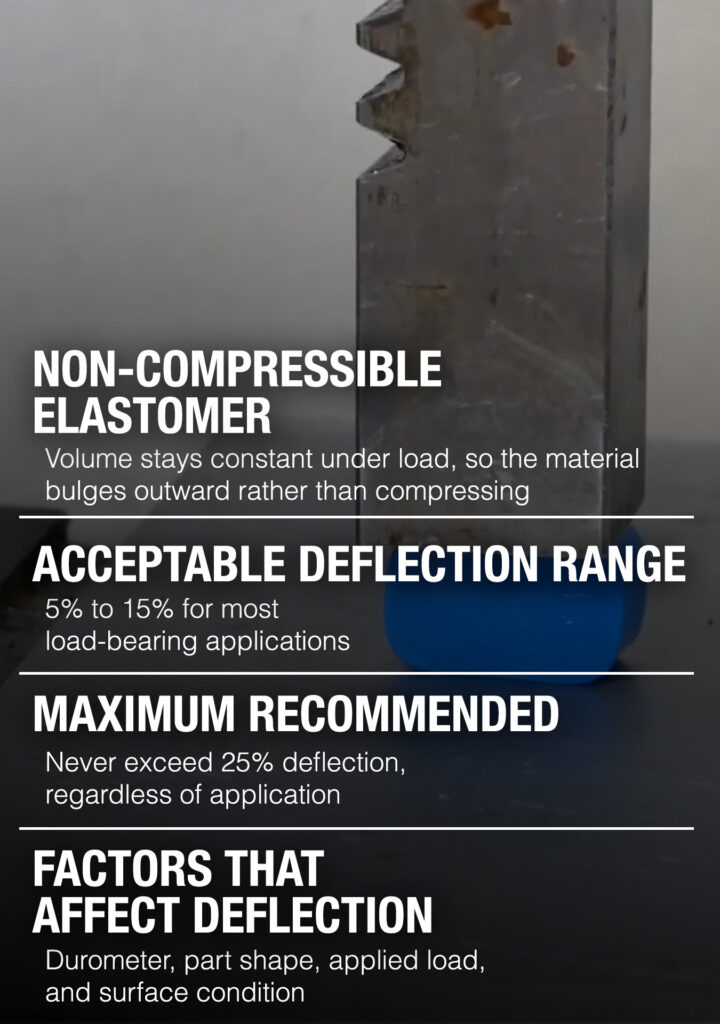
Polyurethane, unlike rubber, is a non-compressible elastomer, meaning its volume will not change. In other words if you squeeze it in one place, it will bulge the same amount in another place. For that reason, it makes an excellent material for load-bearing applications.
In load-bearing applications such as isolation pads, bumpers, bushings, rollers and wheels, it is important to know the amount of deflection the part will have when under load. For most applications a range between 5% to 15% deflection is acceptable. However, applications with rapid continuous deflection may need to be limited to lower deflection percentages. We recommend not exceeding 25% deflection regardless of the application.
FACTORS THAT DETERMINE THE AMOUNT OF DEFLECTION
- Hardness(durometer) of the polyurethane
- Shape of the part
- Amount of load placed on the part
- Condition of the part's loaded surface
Although the formula for calculating compression/deflection was scientifically derived, the many variables involved can make it difficult to precisely predit the outcome. The formula used in example 1 is for pads or cylindrically shaped bumpers only.
Two Important Considerations When Calculating Polyurethane Compression/Deflection
Polyurethane can generate heat in dynamic applications, particularly under repeated or continuous loading. As the material heats up, its effective durometer can decrease, which in turn lowers Young’s modulus and affects polyurethane compression/deflection under load.
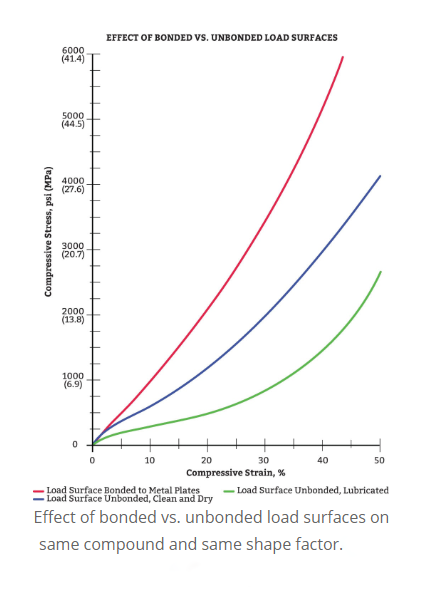
Surface conditions can also significantly affect deflection. A polyurethane part bonded to a surface may behave very differently from the same part compressed between lubricated surfaces. Bonding restricts lateral movement, while lubrication allows the material to bulge outward more freely. Compression/deflection values for parts between surfaces that are neither bonded nor lubricated cannot be accurately calculated using these methods alone.
Ask Our Experts.
Contact us today to learn how we can meet your project’s requirements.
Example 1 - Pads
You have a 92A durometer(hardness) isolation pad that is 6″ long by 3″ wide and 2″ thick, that is under a 3,600 lb load. You want to know how much deflection it will have.
The formula is: L=D x Y x (1+2f2)
D = % of deflection/inch of thickness
L = load or force in psi
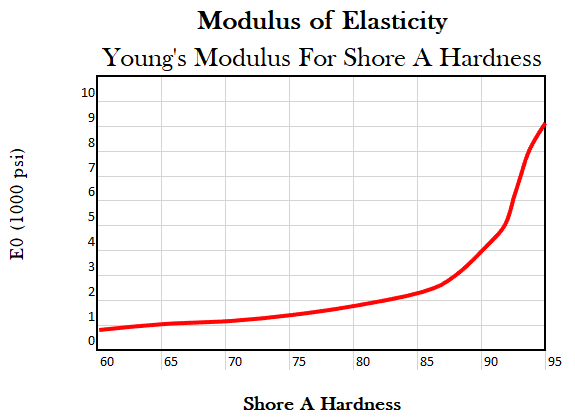
Y = Young’s Modulus (see Modulus of Elasticity Diagram below)
f = shape factor
*The shape factor is determined by dividing the area being pressed by the area that is able to bulge.
Solution To Example 1
L = 3600 lbs ÷ 18 square inches (6 x 3) = 200 psi
Y = 4500 psi for 92A durometer(hardness)
f = 18 (6 x 3) area being pressed ÷ by 36 (2×6+2×3+2×6+2×3) area able to bulge = .5
f2 = .52 = .25 therefore (1 + 2f2) = (1 + (2 x .25)) = 1.5
Using the formula above:
200 = D x 4500 x 1.5
200 = 6750D
200 ÷ 6750 = D
D = .0296 per inch of original thickness (2.9%)
2″ thick pad x .0296 = .0592″ total deflection
Modulus of Elasticity Diagram
As was mentioned above, the condition of the parts loaded surface, has an effect on deflection. When a part is compressed it wants to expand out laterally and that movement changes the shape factor. This is particularly noticeable if the surfaces are lubricated. However, if the surfaces are bonded to a substrate such as metal, the shape factor remains the same. Below is a graph showing the differences in deflection of a bonded part, a dry and clean part and a lubricated part. As you can see, the surface condition of a part can make quite a difference in deflection.
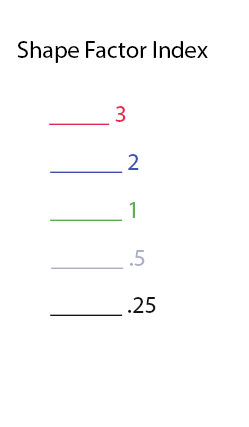
CHARACTERISTICS BY DUROMETER(HARDNESS) AND SHAPE FACTOR
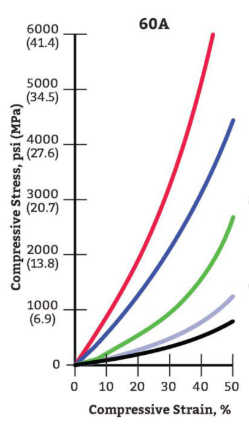
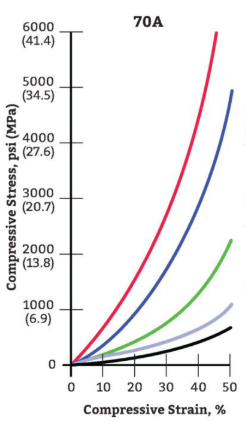
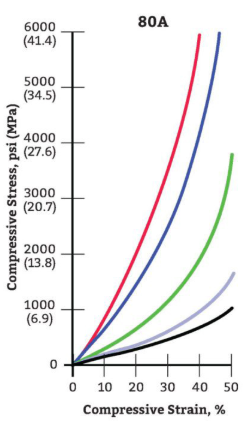
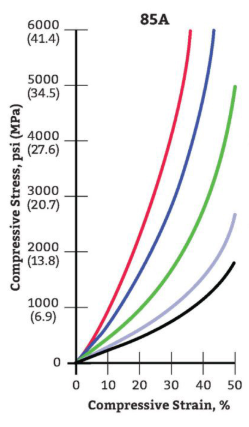
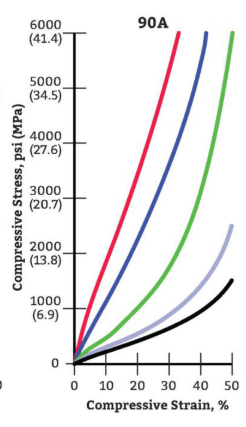
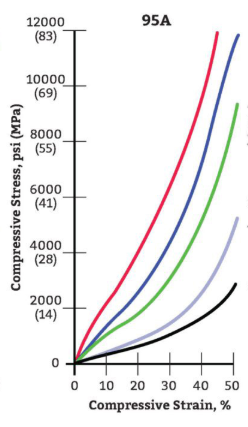
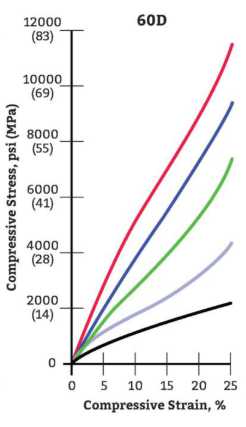
Below are several graphs showing the compression/deflection curve for various shape factors. Each graph is for a different durometer(hardness) of urethane. All samples tested were bonded to metal surfaces.
Example 2 - Wheel/Roller
You have a wheel with a 4″ diameter metal core and a 6″ diameter polyurethane covering. The wheel is 2″ wide and the polyurethane is 92A durometer(hardness). How much will the urethane deflect under a 1000 lb. load?
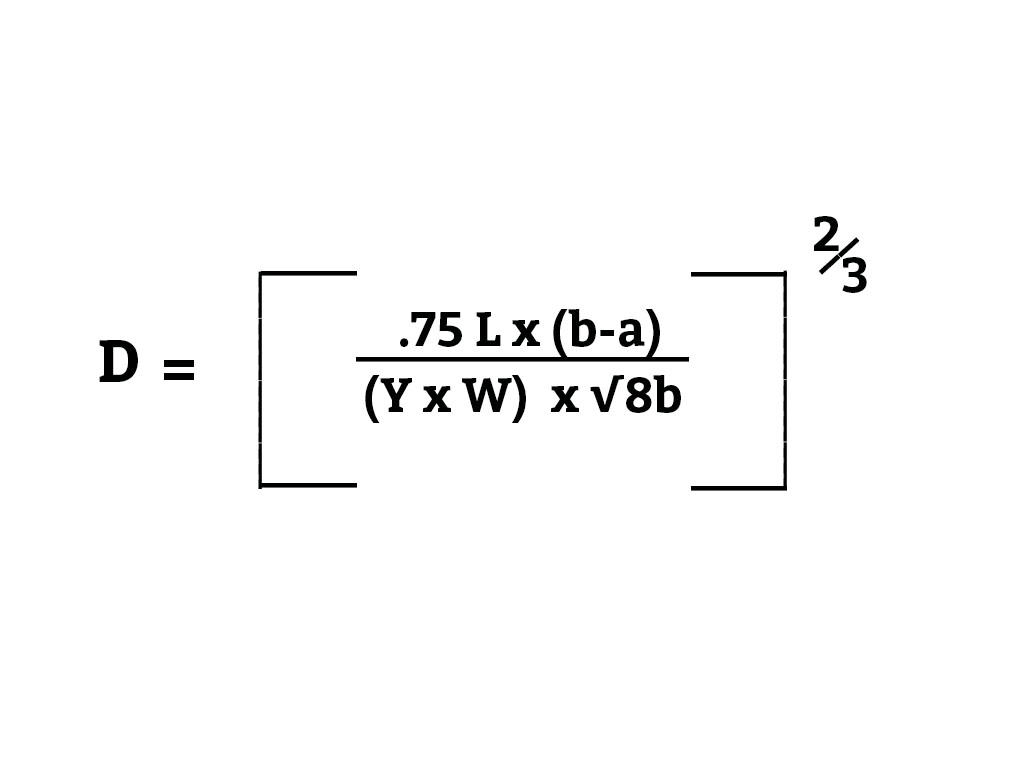
The formula is:
L = The loading or weight in pounds (not psi)
D = Deflection in inches (not a % deflection)
Y = Young’s Modulus (see Modulus of Elasticity diagram above)
W = Width (length of contact surface) of the roller/wheel in inches
a = Inside radius of the polyurethane in inches
b = Outside radius of the polyurethane in inches
Solution To Example 2
L = 1000 lbs
Y = 4500 for 92A durometer(hardness)
W = 2″ wide
a = 2″ radius of 4″ metal hub
b = 3″ radius of 6″ urethane covering
Using the formula above:
.75 L = .75 x 1000 = 750
(b – a) = 3 – 2 = 1
Thus .75 L x (b-a) = 750 x 1 = 750
Y x W = 4500 x 2 = 9000
8b = 8 x 3 = 24 √24 = 4.9
Thus Y W x √8b = 9000 x 4.9 = 44,100
| .75 L (b – a) | = | 750 ÷ 44,100 which equals .017 | |
| Y x W x √8b | |||
.0172/3 = 3√.0172
.0172 = .000289
3√.000289 = .066
Reach out to the team
Polyurethane Pad Compression Deflection Percentage Calculator
The information given by this calculator is baseline, many factors affect compression such as the surrounding environment, your specific application, and the urethane formulation. Get in touch for assistance in finding the product to suit your individual requirements.
POLYURETHANE PAD COMPRESSION DEFLECTION PERCENTAGE CALCULATOR
Wheel and Roller Compression Deflection Percentage Calculator
The information given by this calculator is baseline, many factors affect compression such as the surrounding environment, your specific application, and the urethane formulation. Get in touch for assistance in finding the product to suit your individual requirements.
Wheel and Roller Compression Deflection Calculator
Disc or Ring Compression Deflection Calculator
The information given by this calculator is baseline, many factors affect compression such as the surrounding environment, your specific application, and the urethane formulation. Get in touch for assistance in finding the product to suit your individual requirements.
Disc or Ring Compression Deflection Calculator
Please note that at least one of the following fields must be filled out to proceed.
Recommended Reads
Stress is a measure of the internal reaction force. Strain is the measure of deformation. Hysteresis is the name used to describe the failure of a urethane part…
FAQs
Does polyurethane compress or deflect under load?
Polyurethane is a non-compressible elastomer, so it deflects rather than compresses. Under load its volume stays essentially constant and its mass displaces (bulges) to the side, then it returns to shape when the load is removed. “Compression” describes the force applied; “deflection” describes how the material responds.
What is an acceptable deflection percentage for a polyurethane part?
For most applications, 5% to 15% deflection is acceptable. Applications with rapid, continuous deflection should stay lower. PSI recommends never exceeding 25% deflection, regardless of the application, because stresses inside the part rise sharply beyond that point.
What is the polyurethane compression/deflection formula?
For pads and cylindrical bumpers, L = D x Y x (1 + 2f²), where L is load (as psi, force per unit area), D is percent deflection per inch of thickness, Y is Young’s Modulus (set by formulation and hardness), and f is the shape factor (loaded area ÷ area free to bulge). Load must be converted to psi before use — raw force values give incorrect results.
What is the difference between deflection and compression set?
Deflection is how much a part deforms under an applied load. Compression set is how well the part returns to its original thickness after the load is removed. Low compression set means strong elastic recovery; high compression set means permanent deformation. Compression set matters most under continuous or cyclic loading and elevated temperatures.
How does surface condition (bonded vs. lubricated) affect deflection?
Surface condition changes the shape factor and therefore the deflection. Lubricated surfaces allow the part to expand laterally, lowering effective stiffness and increasing deflection. Bonded surfaces (e.g. to metal) prevent lateral movement, keeping the shape factor constant and increasing stiffness. Values for parts that are neither bonded nor lubricated cannot be calculated accurately.