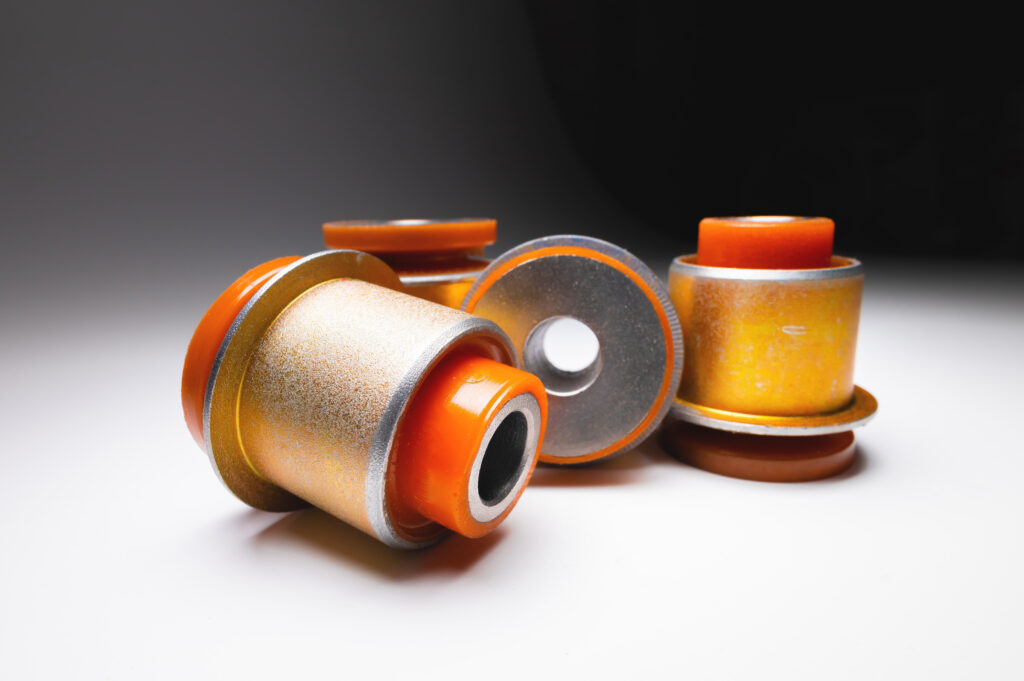
Polyurethane compression refers to how a cast urethane part deforms under load. Unlike compressible materials, polyurethane behaves as a nearly incompressible elastomer. That means when force is applied, the material does not significantly reduce in volume, it displaces laterally, bulging outward as it shortens in the direction of the load.
This behavior is what makes polyurethane so effective in load-bearing applications. It stores energy during compression and releases it when the load is removed, enabling controlled movement, vibration isolation, and shock absorption.
Compared to rubber, polyurethane carries higher loads at the same durometer. This difference is not marginal, it directly impacts part sizing, geometry, and lifecycle expectations. Engineers can often reduce component size while maintaining load capacity, which is a major advantage in constrained designs.
You’ll see polyurethane compression behavior across:
In all of these, the ability to predict how the material deflects under load determines whether the design works, or fails early.
What can your components handle under load? Get expert insight tailored to your application.
Deflection is the percentage of deformation under load. It’s the primary variable engineers design around.
It can be expressed as:
Typical design ranges:
Deflection directly controls stress levels inside the material. Too little deflection, and the part becomes overly stiff. Too much, and you increase the likelihood of tearing, heat buildup, or permanent deformation.
The polyurethane compression set measures how well the material returns to its original shape after load removal.
This becomes critical in applications with:
If the compression set is not accounted for, the part may gradually lose thickness and stop functioning as intended.
The standard polyurethane compression force deflection relationship is:
L = D × Y × (1 + 2f²)
This equation provides a baseline for estimating how polyurethane behaves under load.
Each variable plays a distinct role, but shape factor and modulus typically dominate the outcome.
Load must be expressed as force per unit area (psi). Raw force values are meaningless without converting to stress.
For example:
This conversion is where many calculation errors begin.
Shape factor is one of the most misunderstood variables.
Definition: Loaded area ÷ free-to-bulge area
It determines how much the material is allowed to expand laterally.
Key insight: Two parts made from the same material will behave identically if their shape factors are the same, even if their sizes differ.
This means geometry often influences behavior more than scale.
Young’s Modulus defines stiffness. It varies based on:
Higher durometer materials have higher modulus values, which means:
At PSI Urethanes, formulations are not fixed. Material properties can be tuned to match exact load-deflection requirements rather than forcing the design to adapt to off-the-shelf materials.
Surface interaction changes everything.
Ignoring this factor can skew calculations significantly, especially in bonded assemblies.
Need precise compression and deflection? We’ll match material properties to your design.
Area = 6 × 3 = 18 in²
Load = 3600 ÷ 18 = 200 psi
For 92A polyurethane:
Y ≈ 4500 psi
Loaded area = 18 in²
Free-to-bulge area = perimeter × thickness
= (2×6 + 2×3) × 2
= 18 × 2 = 36 in²
Shape factor:
f = 18 ÷ 36 = 0.5
(1 + 2f²) = 1 + 2(0.5²) = 1.5
Rearranging:
D = L / [Y × (1 + 2f²)]
D = 200 / (4500 × 1.5)
D ≈ 0.0296 per inch
Total deflection:
0.0296 × 2″ = 0.0592 = 5.9%
A 5.9% deflection falls squarely within the recommended 5-15% range.
That indicates:
This is exactly the kind of validation engineers look for before prototyping.
Rubber and polyurethane are often treated interchangeably, but they behave differently under load.
Rubber:
Polyurethane:
The practical outcome:
The formula is not the final answer, it’s a starting point. Real-world variability includes:
Even small changes in formulation can shift modulus values and deflection outcomes.
The bottom line:
Calculations guide design decisions, but testing validates them. This is where experienced manufacturers make a measurable difference.
PSI Urethanes approaches compression design from both a material and geometry standpoint, not just one or the other.
This level of control allows PSI to hit exact compression-deflection targets, rather than forcing customers to compromise.
Polyurethane is often selected when standard elastomers fall short. Typical use cases include:
Common failure modes in other materials:
Custom cast polyurethane avoids these issues by aligning the material directly with the application rather than relying on generic compounds.
Replacing failing rubber or plastic parts? Upgrade to a custom cast urethane solution.
The standard polyurethane compression formula is L = D × Y × (1 + 2f²), where L is load (psi), D is deflection, Y is Young’s Modulus, and f is the shape factor. This equation helps engineers estimate how polyurethane will deform under load and is the foundation for compression force deflection calculations.
To calculate polyurethane deflection, first determine load in psi, assign the material’s modulus (Y), and calculate the shape factor (f). Then rearrange the formula to solve for deflection: D = L / [Y × (1 + 2f²)]. Multiply the result by material thickness to get total deflection.
Shape factor is the ratio of loaded area to free-to-bulge area. It controls how much the material can expand laterally under load. A higher shape factor increases stiffness and reduces deflection, making it one of the most important variables in polyurethane compression design.
Polyurethane has a higher modulus than rubber, meaning it supports greater loads with less deflection. It also offers better energy return and durability, allowing for smaller, more compact designs compared to rubber components in similar applications.