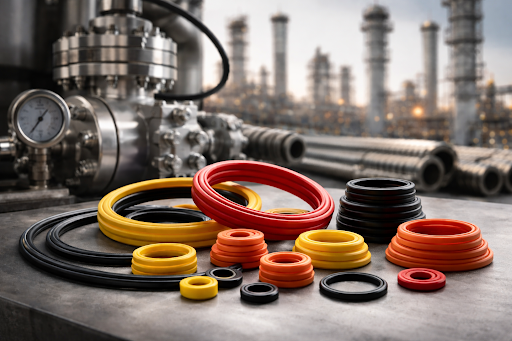
Across the oil and gas value chain (upstream, midstream, and downstream) seals act as the first and last line of defense against system failure. From high-pressure drilling environments to long-distance pipeline transport and refining systems, oil and gas seals maintain containment, regulate pressure, and isolate fluids under extreme conditions.
Critical failure points are everywhere: pumps handling abrasive slurries, valves cycling under pressure, pipelines exposed to temperature swings, and hydraulic systems operating under constant load. In these environments, even a minor sealing issue can cascade quickly.
The consequences are severe and immediate:
Regulatory scrutiny continues to tighten around fugitive emissions and leak prevention. Operators are under constant pressure to adopt materials and sealing solutions that reduce failure risk while maintaining system integrity under increasingly harsh conditions.
Traditional sealing materials (primarily rubber and certain plastics) struggle to maintain reliability under the mechanical, chemical, and thermal demands of oil and gas environments.
Mechanical degradation is one of the most common failure modes. Repeated pressure cycling leads to:
Chemical exposure further accelerates degradation. Hydrocarbons, hydrogen sulfide (H₂S), and aggressive additives can cause swelling, embrittlement, or structural breakdown in many elastomers.
Thermal instability is another limiting factor. High-temperature drilling zones and refining processes push materials beyond their limits, leading to softening, hardening, or loss of elasticity.
Compression set, where a seal loses its ability to rebound after deformation, is a critical long-term issue. Once sealing force drops, leakage becomes inevitable.
In short, conventional materials often fail because they were never engineered for sustained exposure to combined stressors: pressure, motion, temperature, and chemical attack.
Need more reliable oil and gas seals? See how custom urethane solutions can reduce failure risk across your systems.
Cast polyurethane introduces a different category of material behavior. Rather than acting as a compromise between flexibility and strength, urethane delivers both simultaneously.
As an engineered elastomer, cast urethane offers:
Abrasion resistant oil and gas seals made from urethane significantly extend service intervals in high-wear environments such as mud pumps, compressors, and hydraulic cylinders. Instead of gradual material loss leading to leakage, urethane maintains structural integrity even under continuous friction and impact.
This directly translates into fewer replacements, less maintenance intervention, and improved uptime across critical systems.
Leak prevention in oil and gas systems is all about maintaining sealing force under dynamic conditions. Urethane excels in both static and dynamic sealing scenarios. Its ability to resist deformation under pressure spikes allows it to maintain tight contact with sealing surfaces, even as system conditions fluctuate.
This is particularly valuable in:
By maintaining pressure integrity, urethane seals play a direct role in preventing leaks in oil and gas equipment. This reduces fugitive emissions, limits environmental exposure, and supports compliance with increasingly strict regulatory frameworks.
In high-risk systems, the difference between a marginal seal and a properly engineered urethane solution is the difference between controlled containment and uncontrolled release.
Urethane seals are deployed across every segment of the oil and gas industry, particularly in areas where mechanical stress and material wear are unavoidable.
In high-wear zones, custom molded urethane seals consistently outperform traditional materials. Their ability to absorb impact, resist abrasion, and maintain sealing force under load makes them particularly effective in environments where failure is not an option.
Off-the-shelf seals are built for average conditions. Oil and gas environments are anything but average.
Custom molded urethane seals allow engineers to tailor material properties and geometry to specific application requirements. This includes:
The result is an abrasion resistant seal that matches the exact demands of the system it serves. Benefits of custom molded urethane seal design include:
Prototyping plays a critical role here. By developing parts from drawings or field samples, manufacturers can validate design assumptions before full-scale production. This reduces uncertainty and allows for iterative refinement based on real-world conditions.
Dealing with repeated oil and gas seal failures? Let’s engineer a custom molded urethane seal built for your exact application.
With more than 50 years of experience, PSI Urethanes has built its reputation on delivering engineered urethane solutions for demanding applications across hundreds of industries, including oil and gas.
Their manufacturing approach is built around control, speed, and application-specific engineering.
At their 45,000-square-foot facility in Austin, Texas, PSI operates a fully equipped in-house mold-making and tooling shop. This allows for rapid turnaround from concept to finished part.
Their custom casting process follows a structured path:
PSI can produce parts ranging from less than a gram to over 2,500 pounds, with a wide range of hardness levels and formulations available. This flexibility allows them to support everything from small sealing elements to large-scale industrial components.
What sets PSI apart is the integration of engineering support throughout the process. Their team works directly with customers to refine designs, select materials, and meet tight tolerances, delivering parts that align with real-world application demands.
When evaluated against traditional materials, urethane consistently delivers stronger long-term value in demanding sealing applications.
Where rubber and plastics tend to crack, swell, or wear rapidly, urethane maintains structural integrity and sealing capability over time. This makes it a more reliable choice for systems where failure carries high operational and safety consequences.
Selecting the right urethane oil and gas seal requires a clear understanding of the application environment.
Transitioning from standard seals to engineered urethane solutions typically occurs when systems begin to experience repeated failures, excessive wear, or unacceptable leakage rates. At that point, material selection becomes a strategic decision rather than a commodity purchase.
The direction of the oil and gas industry is clear: higher reliability, tighter emissions control, and longer equipment lifecycles.
Sealing technology is evolving to meet these demands. Advanced materials like urethane are playing a growing role in:
At the same time, custom material engineering is becoming a competitive advantage. Operators who move beyond standard components and invest in application-specific solutions are better positioned to manage risk, control costs, and meet regulatory requirements.
Urethane seals represent a shift toward engineered sealing systems built for the realities of modern oil and gas environments.
Want better sealing reliability? Talk with our team about a solution designed around your requirements.
Urethane is one of the best materials for oil and gas seals due to its high abrasion resistance, chemical stability, and ability to maintain sealing force under extreme pressure and temperature conditions. Compared to rubber and plastics, urethane seals offer longer service life and improved reliability in harsh environments.
Oil and gas seals commonly fail due to mechanical wear, chemical degradation, thermal instability, and compression set. Exposure to hydrocarbons, pressure cycling, and abrasive materials can cause traditional seals to crack, swell, or lose elasticity, leading to leaks and system failure.
Urethane seals prevent leaks by maintaining consistent sealing force under dynamic conditions such as pressure fluctuations, motion, and temperature changes. Their resistance to deformation and wear helps ensure tight sealing surfaces, reducing fugitive emissions and improving system safety.
Custom molded urethane seals should be used when standard seals fail to meet performance requirements. They allow for precise control over material properties, geometry, and chemical compatibility, resulting in better fit, reduced leakage, and extended service life in demanding oil and gas applications.