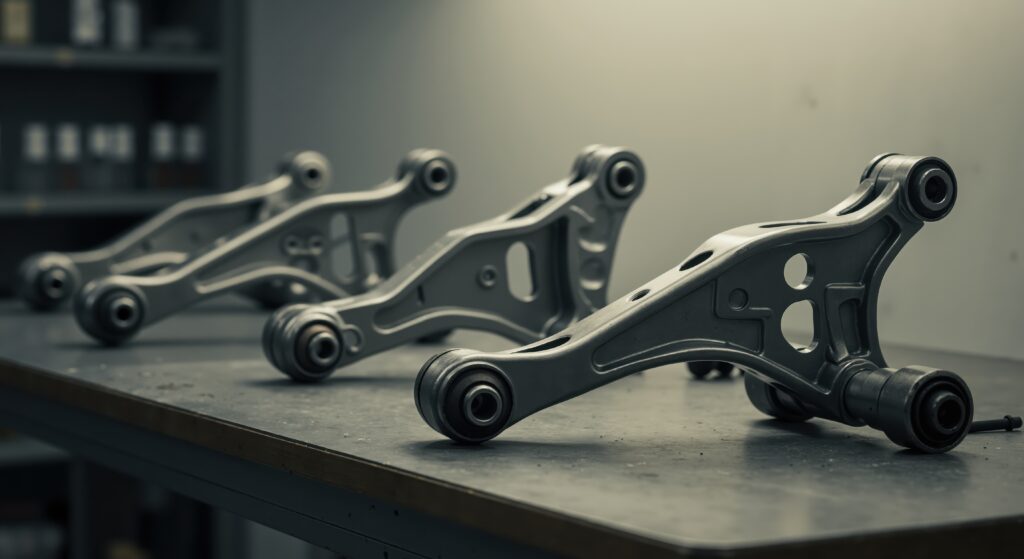
In mechanical systems, failures rarely start with the largest component. They begin at the interfaces, the pivot points, the isolators, the compliant joints. Bushings sit quietly at the center of these stress zones, absorbing load, controlling motion, and separating dissimilar materials. When they fail, the consequences cascade: vibration increases, alignment shifts, wear accelerates, and downtime follows.
Premature wear, cracking under cyclic load, corrosion, and vibration transfer are not random events. They are material problems. In many assemblies, the default choice has historically been rubber or metal. But modern equipment subjects bushings to higher loads, tighter tolerances, aggressive chemicals, and extended duty cycles that exceed what those materials were originally designed to handle.
When evaluating polyurethane bushings vs rubber, the difference becomes clear under load, heat, and chemical exposure. Rubber can soften, swell, and tear. Metal can corrode, gall, and transmit shock directly into the assembly. Cast polyurethane, by contrast, provides engineered compliance with significantly higher mechanical strength.
In high-load, high-cycle, and chemically aggressive environments, cast polyurethane consistently outperforms both rubber and metal.
A bushing is a compliant interface placed between two components to control motion and distribute load. While small in size, it performs several mechanically critical functions:
Applications span industries:
From a design standpoint, bushings must satisfy demanding requirements:
Need better bushings for demanding applications? See how engineered polyurethane can improve your next build.
Rubber is valued for elasticity. However, it exhibits lower tensile strength and tear resistance compared to cast polyurethane. Under sustained load, rubber is prone to compression set, permanent deformation that reduces preload and compromises alignment.
Polyurethane bushings vs rubber delivers higher tensile strength, superior tear resistance, and greater resistance to compression, allowing it to retain its shape even under sustained load.
One major engineering advantage lies in polyurethane’s durometer range. Cast formulations can span from 25 Shore OO to 75 Shore D, allowing engineers to precisely tune stiffness, load-bearing capability, and deflection characteristics. Rubber lacks this level of tunable mechanical range.
With polyurethane bushings vs rubber, the difference is not incremental. It is structural.
In dynamic systems with sliding or oscillating motion, abrasion resistance dictates service life. Rubber deteriorates under friction, generating particulates and gradually losing material thickness. Over time, clearances increase and alignment degrades.
Polyurethane exhibits exceptional abrasion resistance due to its segmented polymer structure. The result:
Rubber is susceptible to swelling when exposed to oils and fuels. It can degrade under UV and ozone exposure, leading to surface cracking. Properly formulated polyurethane offers:
Metal bushings provide rigidity, but no compliance. They require lubrication to reduce friction and are prone to galling, corrosion, and wear. More critically, metal transmits vibration directly into the assembly.
Under shock loading, metal bushings concentrate stress at interfaces, accelerating fatigue in adjacent components.
Polyurethane offers controlled deflection:
Consider two real-world examples:
Have a challenging load or environment to solve? Let PSI Urethanes help create the right polyurethane solution.
Polyurethane can be engineered for specific stiffness, energy absorption, and load-bearing needs. This adaptability allows precise tuning for each application.
Specialty formulations include:
This flexibility makes polyurethane suitable for aerospace assemblies, food equipment, military systems, and high-speed industrial machinery.
Under cyclic loading, materials accumulate damage. Rubber experiences internal heat buildup and progressive crack growth.
Polyurethane exhibits superior fatigue resistance due to its segmented polymer structure and controlled hysteresis. It balances energy absorption and rebound, allowing recovery after repeated compression and shear cycles.
In comparative fatigue testing, polyurethane consistently outlasts rubber in dynamic compression and oscillation environments.
The compression set directly affects alignment. Rubber often loses dimensional stability under sustained load.
Cast polyurethane maintains tight tolerances over time, resisting permanent deformation. For assemblies requiring precise geometry, aerospace linkages, industrial presses, high-performance suspension systems, this stability is critical.
Unlike rubber, polyurethane can be chemically bonded directly to metal substrates during casting. This eliminates secondary mechanical retention methods and improves load distribution.
Bonded assemblies reduce slippage, distribute stress more evenly, and simplify assembly design.
A common misconception is that all polyurethane bushings require lubrication.
In many static or low-motion applications, lubrication is unnecessary. However, in dynamic suspension systems or oscillating joints, specialized polyurethane bushing grease plays an important role.
Proper grease:
Petroleum-based greases can degrade certain elastomers. Silicone-based or polyurethane-compatible lubricants are recommended when required.
Correct lubrication practices enhance longevity, but the base material remains the primary driver of reliability.
Shock-loading environments separate materials quickly. Applications include:
Polyurethane shock bushings excel because they absorb energy rather than transferring it directly. They resist tearing under rapid compression, recover without cracking, and maintain structural integrity across repeated impact cycles.
Material science alone does not determine final properties. Processing matters. At PSI Urethanes, cast polyurethane components are produced through controlled casting systems supported by in-house mold design and tooling. Precision tolerance control, consistent cure cycles, and rigorous quality oversight drive part-to-part consistency.
Capabilities include:
Manufacturing discipline determines whether theoretical material properties translate into real-world mechanical behavior.
PSI Urethanes produces custom molded polyurethane products engineered for specific load, chemical, and environmental conditions, not generic substitutions for rubber.
Industries Where Polyurethane Bushings Deliver Measurable Advantage
Higher load capacity and improved energy absorption support suspension geometry stability.
Abrasion resistance reduces wear in repetitive press cycles.
Dimensional stability and bonded assemblies support tight tolerances.
FDA-compliant formulations and chemical resistance withstand washdowns.
Fire-resistant and static dissipative formulations support demanding operational environments.
Across sectors, the advantage traces back to mechanical strength, chemical stability, and tunable compliance.
Material selection should not be guesswork.
PSI Urethanes manufactures custom molded polyurethane bushings, bonded assemblies, and precision components tailored to your load, chemical exposure, and lifecycle requirements. From prototype-to-production, supported by in-house tooling and controlled casting processes, PSI delivers engineered polyurethane solutions built for real mechanical demands.
Ready to replace rubber or metal bushings? Talk with our team about a custom polyurethane design.
In most high-load or high-cycle applications, polyurethane bushings outperform rubber bushings. Polyurethane offers higher tensile strength, greater tear resistance, and better resistance to oils, chemicals, and abrasion. This allows polyurethane bushings to maintain alignment and structural stability longer than traditional rubber bushings.
Polyurethane bushings do not always require lubrication. In low-motion or static applications they can operate without grease. However, in suspension systems or oscillating joints, using a polyurethane-compatible bushing grease helps reduce friction, prevent squeaking, and extend service life.
Polyurethane bushings combine high mechanical strength with controlled flexibility. Their durometer can be engineered to achieve precise stiffness and energy absorption, allowing them to handle heavy loads, repeated impact, and vibration while maintaining dimensional stability.
Polyurethane shock bushings are designed for high-impact environments such as suspension systems, industrial presses, and heavy machinery. They absorb and distribute shock loads, reducing stress on surrounding components and improving durability in dynamic mechanical systems.