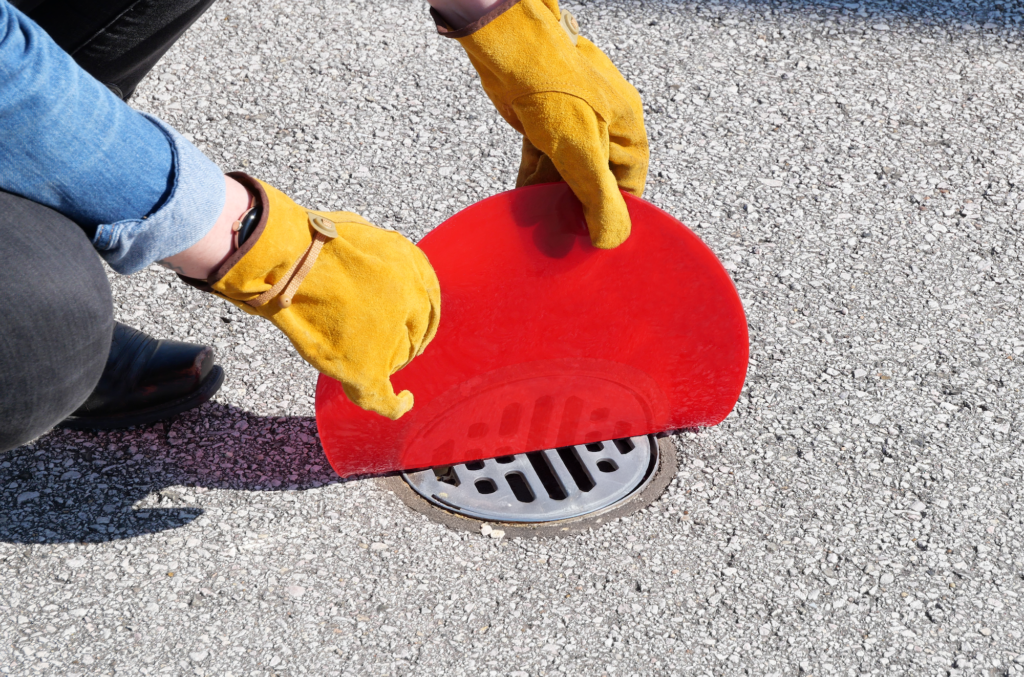
Drain protection fails for predictable reasons: mechanical stress, chemical incompatibility, and abrasion. Industrial floors are not laboratory test surfaces. They are dynamic environments where equipment traffic, corrosive fluids, and debris converge.
Forklifts, pallet jacks, carts, and dropped tools subject floor surfaces to constant impact and compression. Drain covers positioned in these areas experience:
Conventional rubber hardens and cracks under this stress. PVC splits. Edges curl upward. Once the sealing surface deforms, liquid bypass becomes unavoidable.
PSI’s polyurethane drain protectors are cast from high-strength elastomer systems that resist cracking under dynamic loading and maintain conforming contact even after repeated deployment cycles.
Facilities handling acids, caustics, fuels, solvents, oils, and process chemicals cannot rely on materials rated for general-purpose exposure.
Incompatible elastomers swell, soften, or chemically degrade. That deformation compromises drain cover seals during the exact moment they are needed most: a spill event.
PSI polyurethane formulations resist a wider range of chemicals than most rubbers and plastics. This expanded resistance profile is one reason the original DrainProtector® Safety Seal became a global benchmark in spill response.
Metal shavings, sand, food waste, paper fibers, and grit grind into elastomer surfaces. The top surface is designed to deflect debris and resist the mechanical stress of a busy workspace.
Urethane’s abrasion resistance reduces surface thinning and edge deterioration compared to many commodity elastomers. That translates to longer usable life in harsh industrial conditions.
Drain protection is only effective if the material survives both mechanical and chemical abuse.
Ready to stop hazardous spills before they reach your drainage system? Discover what PSI’s polyurethane drain protectors can do for your facility.
Polyurethane elastomers’ segmented polymer structure provides a combination of strength and elasticity that commodity elastomers struggle to match.
Urethane exhibits:
In spill containment scenarios, this matters. A torn edge compromises the entire barrier.
PSI’s polyurethane drain covers are designed to withstand real-world impact conditions common in manufacturing plants, warehouses, and industrial facilities.
Polyurethane drain protectors from PSI resist:
For facilities dealing with aggressive substances, PSI can tailor formulations to address specific exposure profiles. Chemical compatibility evaluation, including swell testing and immersion analysis, guides material selection.
Compared to rubber and PVC, urethane withstands sliding metal, debris, and abrasive contact far more effectively. For facilities deploying drain covers repeatedly, this abrasion resistance reduces replacement frequency and stabilizes lifecycle cost.
PSI’s drain protectors use a high-tack polyurethane sealing surface designed to conform to real industrial flooring conditions. The naturally tacky underside of the original DrainProtector® Safety Seal grips concrete and coated floors, molding itself to minor surface irregularities.
Industrial floors often contain texture variations, cracks, and uneven coatings that can create leak paths. PSI’s high-tack polyurethane surface:
This conforming seal helps prevent liquid bypass during spill events without the need for additional urethane sealant or mechanical fastening.
Hardness impacts:
Too rigid, and the cover may not conform to floor irregularities. Too soft, and it may distort under load. Proper durometer selection is fundamental to industrial spill containment reliability.
Molded drain covers provide:
PSI offers ready-to-go square sizes of 18, 24, 36, 42, and 48 inches for fast response, along with fully custom dimensions.
Concrete texture, coating condition, and environmental exposure influence seal behavior. Outdoor installations must account for temperature extremes and UV exposure.
Polyurethane systems can be formulated to address these environmental variables.
Generic covers often feature:
They may suffice for light-duty environments but struggle in high-abuse settings.
PSI’s polyurethane drain protectors provide:
PSI is the manufacturer of the original DrainProtector® Safety Seal, recognized worldwide. Its tackiness, chemical resistance, and ease of use continue to set it apart.
The DrainProtector® II introduces a reversible design for extended usability in demanding environments.
With in-house engineering and mold-making capabilities in Austin, Texas, PSI moves from concept to finished tooling efficiently. Scalable production supports both limited runs and full-scale manufacturing.
Need a custom urethane drain cover built for your environment?
PSI polyurethane drain protectors are deployed across thousands of companies worldwide in sectors including:
Each of these environments faces potential spill scenarios with environmental and financial consequences.
EPA and local spill control regulations require documented containment measures. Failed containment can lead to fines, reporting requirements, and reputational impact.
Spill events interrupt production schedules and require labor-intensive remediation. A compromised drain seal increases secondary damage risk.
Replacement frequency, chemical degradation, and abrasion resistance determine long-term cost. Polyurethane’s mechanical strength and chemical stability reduce recurring replacement cycles.
With over five decades of cast polyurethane development and membership in the Polyurethane Manufacturers Association (PMA), PSI continues to advance material science for demanding industrial applications.
Operating from a 45,000 sq. ft. facility in Austin, TX, PSI controls tooling, molding, and finishing in-house, maintaining strict dimensional standards and rapid turnaround capability.
As a family-owned manufacturer, PSI emphasizes craftsmanship and accountability in every polyurethane drain cover and drain protector produced.
A urethane drain cover is a frontline barrier in your industrial spill containment plan.
When exposure includes abrasion, repeated impact, and aggressive chemicals, commodity elastomers fail in predictable ways.
Engineered polyurethane does not.
PSI Urethanes manufactures the original DrainProtector® Safety Seal and advanced polyurethane drain covers used worldwide. If your environment includes chemical exposure, heavy equipment traffic, or abrasive debris, material selection determines risk.
Choose a solution built around polymer science, not assumptions.
What can PSI’s original DrainProtector® Safety Seal do for your spill containment strategy? Connect with our team today.
A urethane drain cover offers superior tear strength, abrasion resistance, and chemical compatibility compared to many rubber or PVC products. Its segmented polymer structure allows it to withstand repeated mechanical impact, aggressive chemicals, and abrasive debris without cracking or deforming. In industrial spill containment environments, this durability directly impacts seal reliability.
Yes, properly formulated polyurethane systems resist hydrocarbons, petroleum oils, and many industrial chemicals. However, compatibility depends on the specific chemical exposure. Swell testing and immersion analysis are recommended to confirm that the selected urethane chemistry maintains integrity during a spill event.
Molded urethane drain covers provide full-surface, reusable spill containment for rapid deployment during emergencies. Urethane sealant is better suited for reinforcing drain perimeters or filling cracks. Facilities often use both as part of a comprehensive industrial spill containment strategy.