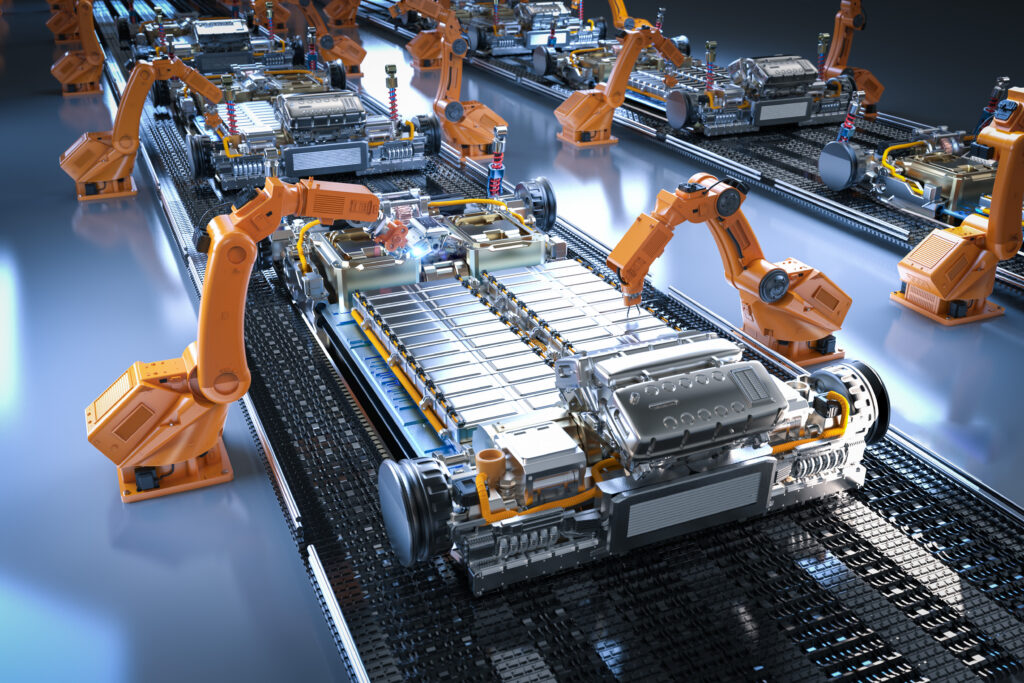
EV factories operate under extreme production pressure. A single failed conveyor roller, damaged robotic gripper, or worn transfer pad can interrupt synchronized manufacturing systems and create expensive downtime across an entire facility. Compared to traditional automotive assembly, EV manufacturing introduces additional challenges including abrasive battery materials, precision handling requirements, chemical exposure, and high-speed automation.
These environments are forcing manufacturers to rethink material selection. Increasingly, advanced urethane manufacturing is being used to reduce maintenance intervals, extend equipment life, improve handling consistency, and lower total production costs.
From urethane automotive parts used in automated handling systems to EV battery protection components that reduce battery damage during transport, cast urethane offers a unique balance of flexibility, toughness, abrasion resistance, and chemical stability that many traditional materials struggle to match.
For more than 50 years, PSI Urethanes has produced custom cast urethane products for demanding industrial environments. With in-house engineering, tooling, and mold-making capabilities, PSI develops custom urethane solutions built for high-cycle manufacturing systems.
Battery manufacturing places significant stress on production equipment. Conveyor systems, robotic handling systems, and automated guided vehicles operate continuously while handling abrasive materials and delicate battery assemblies.
Common production challenges include:
Traditional rubber components often deform under sustained loads. Plastics may crack during repetitive stress cycles, while metal contact surfaces can transfer excessive force into sensitive battery assemblies.
Even minor component failures can stop highly synchronized EV production systems. A damaged roller or worn gripping surface may lead to:
Because battery systems represent one of the most expensive parts of an EV, small handling failures can create major financial losses.
EV manufacturers increasingly evaluate materials based on lifecycle economics rather than initial purchase cost. Engineering teams now focus on:
This shift has made advanced cast urethane a valuable engineering material for high-volume EV facilities.
Need custom cast urethane parts for demanding EV manufacturing environments? PSI Urethanes builds solutions for high-cycle industrial applications.
Battery modules require careful handling throughout production and transport. Cast urethane absorbs and disperses impact forces better than many rigid plastics or metals, making it useful for:
Softer contact surfaces help reduce the risk of dents, scratches, and cracked battery housings during repetitive handling cycles.
Continuous-motion manufacturing creates constant friction between moving surfaces. Cast urethane performs exceptionally well in:
This helps reduce replacement frequency while supporting longer production runs between maintenance shutdowns.
Battery production environments expose components to lubricants, coolants, cleaning compounds, and industrial chemicals. Properly formulated urethane resists degradation better than many traditional elastomers, helping components maintain structural integrity longer.
Automated manufacturing systems generate significant vibration that can affect robotic accuracy and sensor consistency. Cast urethane naturally dampens vibration and noise, making it valuable in pads, mounts, and transfer systems throughout EV facilities.
Conveyor systems form the backbone of EV production. Common urethane applications include:
These components help reduce wear while minimizing maintenance intervals across high-throughput production lines.
Battery modules require precise positioning during manufacturing. Urethane-coated gripping systems help prevent:
The controlled flexibility of urethane allows manufacturers to balance grip strength with impact absorption.
EV battery protection systems frequently use cast urethane in:
These applications require both structural support and controlled flexibility to protect delicate battery assemblies during transport and handling.
Custom urethane sheeting supports:
PSI Urethanes manufactures both stock and custom urethane sheeting with precision thickness tolerances and custom hardness options for industrial manufacturing applications.
Facing creates flat surfaces perpendicular to the axis of rotation and is often used to finish ends of rollers, tubes, and molded components.
A cutting angle of approximately 15 degrees is generally recommended.
Cutting speeds and feed rates are similar to those used during turning.
To achieve quality surfaces:
EV manufacturing rarely relies on one-size-fits-all materials. Urethane formulations can be engineered for:
PSI Urethanes supports custom formulation development for demanding industrial environments requiring specialized material properties.
Rapid iteration is critical inside EV factories. Manufacturers regularly refine conveyor systems, robotic handling systems, and transport equipment to reduce inefficiencies and improve throughput.
PSI’s in-house engineering, tooling, and custom mold-making capabilities support fast-turnaround prototype development and custom production runs.
Automation systems rely heavily on dimensional consistency. Even small part variations can affect robotic alignment and conveyor tracking.
PSI Urethanes has decades of experience manufacturing custom cast urethane components with tight tolerances for industrial automation systems.
Looking to reduce downtime and battery handling damage? Discover custom urethane solutions from PSI Urethanes.
Rubber components often experience compression set and accelerated wear during sustained industrial loading, leading to shorter replacement cycles.
Rigid metal surfaces may transfer excessive force into battery systems, increasing the risk of cosmetic and structural damage.
Many plastics become brittle under repetitive loading cycles, vibration, and chemical exposure, especially in automated manufacturing environments.
Cast urethane combines:
This hybrid material profile makes it highly valuable in demanding EV production environments.
Longer-lasting components can help reduce:
Shock absorption and vibration damping help reduce stress transfer into surrounding systems, potentially extending equipment lifespan.
Reducing dents, scratches, and battery handling damage can significantly lower scrap costs inside high-volume EV production facilities.
Fewer component failures contribute to more stable production schedules and reduced unplanned shutdowns.
Many manufacturers now evaluate components based on total lifecycle cost rather than upfront purchase price alone.
EV facilities frequently require:
Standard components often cannot fully address these requirements.
Vertically integrated urethane manufacturing provides:
PSI Urethanes operates a 45,000-square-foot urethane manufacturing facility in Austin, Texas with:
EV production environments continue demanding more from manufacturing materials through increased automation, continuous production cycles, abrasion, vibration, and chemical exposure.
From urethane automotive parts used in automated handling systems to EV battery protection applications that reduce damage risk during transport, cast urethane can help manufacturers lower downtime, reduce maintenance costs, improve equipment lifespan, and support more stable production environments.
With over five decades of custom urethane manufacturing experience, PSI Urethanes continues helping industrial manufacturers develop custom cast urethane solutions built for demanding applications.
Need precision urethane sheeting or molded components? Talk with PSI Urethanes about your next project.
Urethane is used in EV manufacturing facilities because it offers excellent abrasion resistance, impact absorption, chemical resistance, and durability. Compared to traditional materials like rubber, plastic, and metal, cast urethane can help reduce equipment wear, improve production uptime, and protect sensitive battery components during automated manufacturing processes.
Common urethane automotive parts used in EV factories include conveyor rollers, robotic grippers, wear strips, transfer pads, protective liners, bushings, and battery handling components. These parts help improve material handling performance, reduce maintenance requirements, and extend equipment life in high-cycle production environments.
Urethane supports EV battery protection by cushioning battery modules during transport, handling, and assembly. Applications such as impact buffers, protective padding, transport fixtures, and spacing components help reduce scratches, dents, and structural damage while maintaining precise positioning throughout the manufacturing process.
Custom urethane manufacturing reduces production costs by extending component lifespan, lowering maintenance frequency, minimizing unplanned downtime, and reducing product damage. By improving equipment reliability and operational efficiency, custom urethane solutions can help EV manufacturers achieve a lower total cost of ownership over time.