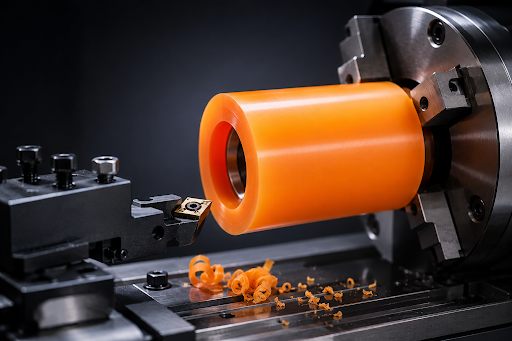
While advances in molding technology and modern urethane casting machine capabilities have expanded what’s possible with cast polyurethane manufacturing, machining remains an important part of producing custom urethane components.
Many manufacturers machine cast urethane to create prototypes, avoid tooling costs, modify existing parts, or produce low-volume runs where molds may not be practical. In other cases, machining is used as a secondary process to achieve precise dimensions after casting.
However, machining polyurethane is very different from machining steel, aluminum, or rigid plastics. As an elastomer, urethane bends, recovers, and retains heat in ways that create unique challenges during cutting.
For more than 50 years, PSI Urethanes has helped customers across industries develop custom cast polyurethane solutions, combining advanced casting capabilities with machining expertise to support everything from prototypes to full-scale production.
Unlike metals, cast urethane does not remain rigid during machining. The material can deflect away from the cutting tool, resulting in less material being removed than expected. In some cases, the opposite occurs, with the material pulling into the tool and creating an overcut condition.
Elastic recovery also affects dimensional accuracy. After a tool passes through the material, urethane can partially rebound toward its original shape. Components produced using a urethane casting machine often require secondary machining to achieve final dimensions.
Heat presents another challenge. Because urethane is a good thermal insulator, it retains heat generated during machining. Excessive temperatures can lead to smearing, tearing, surface defects, or localized melting.
Not all cast urethanes can be machined the same way. Properties such as:
all influence machinability.
Two materials with the same hardness may respond very differently during machining due to variations in formulation.
Expert Tip: PSI Urethanes offers specialized cast polyurethane formulations developed specifically for machining applications. Selecting the right material before machining begins can significantly improve cutting results and dimensional consistency.
Need a custom cast urethane solution? PSI Urethanes can help from prototype to production.
Hardness has a major influence on machinability. Harder urethanes generally machine more like rigid plastics and are easier to cut accurately. Softer materials tend to deflect more under cutting forces, making dimensional control more difficult.
As material softness increases, tool geometry and cutting parameters become increasingly important.
Hardness alone does not tell the whole story.
Physical properties such as tear strength and rebound can vary significantly between materials of the same durometer. These differences affect chip formation, heat generation, and surface finish quality.
Heat control is one of the most important aspects of machining polyurethane.
Because urethane retains heat, aggressive cutting can quickly cause softening or melting. Coolants are commonly used to reduce temperatures and improve cutting conditions.
Freezing can temporarily stiffen urethane and reduce material movement during machining. Because urethane contracts when cooled and expands again as it returns to room temperature, dimensional changes can occur throughout the machining process. The impact of freezing can vary depending on the urethane formulation, part geometry, and machining requirements.
Turning polyurethane is commonly used to machine rollers, tubes, sleeves, bushings, and other cylindrical components. Machining parameters such as cutting speed and feed rate can vary depending on the polyurethane formulation, hardness, tooling, part geometry, and surface finish requirements.
Turning tools require:
These features reduce rubbing and help minimize heat generation.
Common turning challenges include:
Material pushing away from the tool
Overcutting
Poor surface finish
Many manufacturers use near-net-shape casting followed by turning to finish urethane rollers and cylindrical components while minimizing material waste.
Facing creates flat surfaces perpendicular to the axis of rotation and is often used to finish ends of rollers, tubes, and molded components.
A cutting angle of approximately 15 degrees is generally recommended.
Cutting speeds and feed rates are similar to those used during turning.
To achieve quality surfaces:
Milling is often used for:
It provides flexibility when features cannot be created through turning alone.
Because urethane compresses easily, fixturing is critical.
Best practices include:
Improper fixturing can create dimensional inaccuracies even when cutting parameters are correct.
Grinding is often selected when applications require:
Grinding generates significant surface heat, which can cause:
To improve results:
These practices are particularly important when working with tight tolerances.
Looking for a machining-friendly polyurethane formulation? Our experts can help.
Among all machining methods, sawing polyurethanes is often one of the simplest and most effective. Bandsaws typically outperform other saw types because their longer blades run cooler, reducing the risk of melting. Benefits include:
Bandsaws are commonly used to cut:
In many applications, sawing serves as the first step before additional machining processes.
Drilling and boring urethane is often difficult because the material compresses during clamping, making it challenging to maintain roundness and dimensional accuracy. Heat generated during chip removal can also soften the material.
Drilled or bored holes may create:
These defects can reduce tear strength and shorten component life.
Whenever possible, holes and countersinks should be molded directly into the part rather than machined afterward.
Molded features often provide:
Machining is often preferred for:
These applications often benefit from avoiding tooling costs.
Molding is typically the better choice for:
Many manufacturers use a urethane casting machine to create near-net-shape parts before performing final machining. Near-net-shape casting followed by secondary machining reduces material waste while achieving final dimensions more efficiently.
PSI Urethanes works with customers throughout the product development process, providing:
By considering machining requirements during material selection, PSI helps customers avoid common challenges before production begins. PSI’s manufacturing capabilities include custom molding using advanced urethane casting machine processes and secondary machining services.
Since 1966, PSI Urethanes has supplied custom cast polyurethane products to industries worldwide. Capabilities include:
From conveyor rollers and wear components to food processing equipment, metal forming applications, aerospace assemblies, and military hardware, PSI combines decades of polyurethane expertise with advanced manufacturing capabilities to help customers produce high-quality components efficiently.
By combining decades of material expertise with advanced urethane casting machine capabilities, PSI Urethanes helps customers move efficiently from prototype to production.
Have a challenging application? Let’s find the right urethane solution together.
Yes. Cast urethane can be machined using turning, milling, grinding, and sawing processes. However, because urethane is an elastomer, it behaves differently than metals and rigid plastics, requiring specialized tooling, cutting speeds, and heat management techniques.
Sawing polyurethanes with a bandsaw is often the most efficient cutting method. Bandsaws generate less heat, provide cleaner cuts, and reduce the risk of material melting compared to many other machining methods.
Freezing urethane can temporarily stiffen the material and reduce movement during rough machining operations.
Common signs include excessive vibration, belt mistracking, rising maintenance costs, increased operating noise, premature roller failures, and recurring wear at transfer points. Upgrading to engineered urethane conveyor components can help reduce downtime and extend system life.